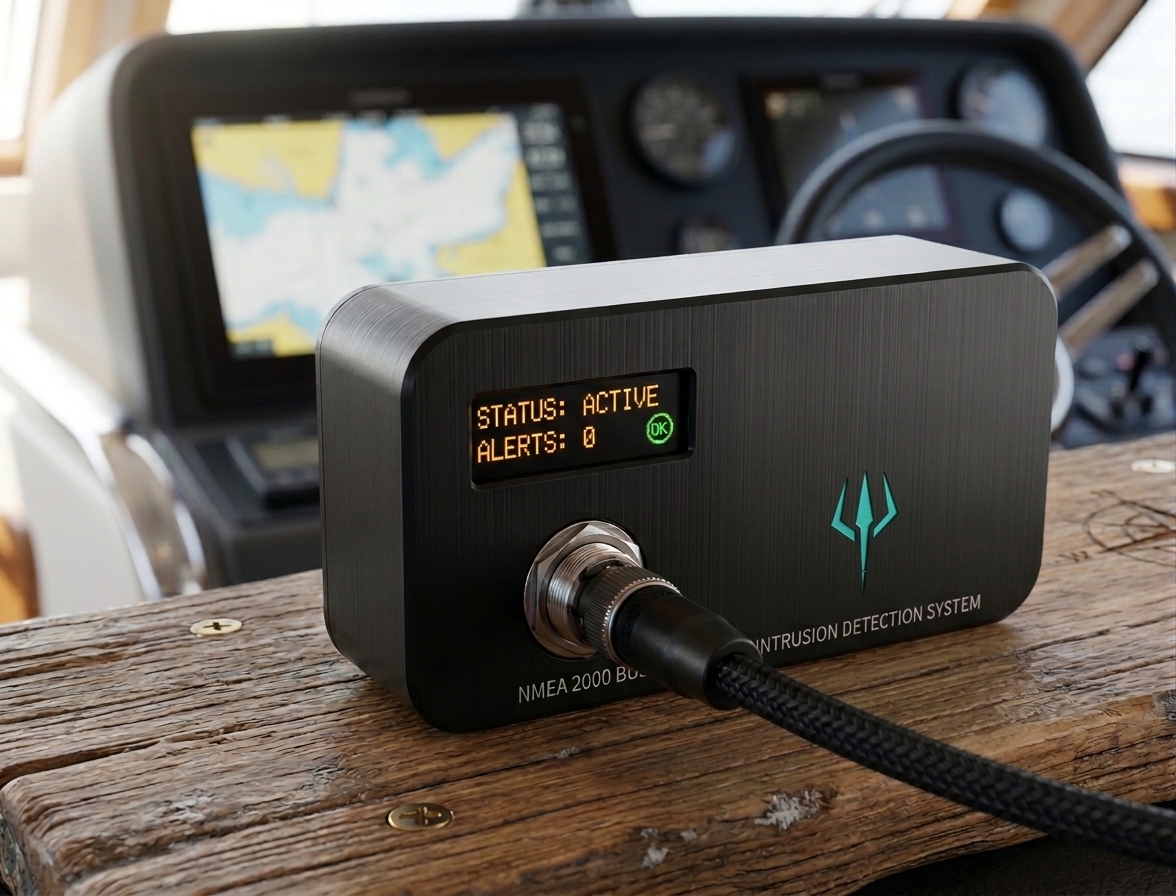
NMEA 2000
INTRUSION DETECTION
Passive NMEA bus monitoring for every vessel in your fleet.
Passive NMEA bus monitoring for every vessel in your fleet.
Conventional IDS tools monitor Ethernet. Ship navigation runs on NMEA 2000, a completely separate physical medium that these tools cannot see. A single spoofed message on this bus can compromise mission-critical navigation equipment. The threat surface is growing. Modern ECDIS systems update over the air, IoT devices feed NMEA telemetry, and indirect remote access channels to the navigation bus now exist over the public internet. Intrusion detection on the NMEA network is no longer optional.
Your Ethernet IDS sees nothing on the navigation bus. N2KD gives you eyes on the one network where a single spoofed message can put the vessel off course.
Know about attacks on your navigation systems before they affect bridge equipment. Alerts reach your operations team in real time, not after the fact.
Completely passive. The device never transmits, never interferes with navigation, and is invisible to every other instrument on the bus. Deploy without downtime.
Low-cost hardware that scales to every vessel in your fleet. Centralized alert management through Rudra MarineSecure or any SIEM via syslog.
Continuous monitoring of your navigation network generates audit-ready evidence for E26 assessments and class society surveys.
Operate independently on a single vessel, or feed into the Rudra Defend module for correlated threat detection across both Ethernet and NMEA networks.
The device sits on the NMEA 2000 backbone as another node, but in hardware listen-only mode. It never transmits, never acknowledges, and is invisible to every other device on the bus.
Feeds alerts to the Rudra MarineSecure fleet dashboard, any SIEM via syslog, or operates standalone. Integrates with Rudra Defend for correlated threat detection across both Ethernet and CAN bus networks.
Request specifications or schedule a technical discussion.